How to Choose the Right Cake Size for Your Event
Choosing the right cake size is one of those small decisions that quietly determines whether a celebration feels easy or slightly chaotic, so it is worth getting right before you place the order.
Most people start with the same practical questions: How many guests am I really serving? Will people want a full dessert portion or a small party slice? Should I size up for seconds, children, or leftovers? And when does a simple single-tier cake stop being enough? Those are sensible questions, because cake math gets fuzzy fast once invitations, dinner, and dietary needs enter the room.
For broader planning context, teams can compare guidance from Google Search Central before choosing a workflow.
A good cake plan matters because the cake is usually served near the end of an event, which means it has to work with the rest of the menu rather than fight it. A birthday after pizza needs a different portion plan than a wedding dessert table. A baby shower with tea and fruit needs a different plan than a graduation party with teenagers who think “one slice” is a suggestion. The practical goal is simple: enough cake for the room, without buying a cake that could feed the next neighborhood over.
In this guide, I will walk through standard cake sizes, realistic serving ranges, guest-count planning, and a few special-case tips that make ordering easier. If you want more general reading, you can return to the homepage, browse the blog, or use the contact page if you want to suggest another practical kitchen guide.
What “cake size” really means
Before you choose a cake, it helps to define the terms bakers use:
Related implementation details are also covered in WordPress documentation, which helps keep tool decisions grounded in established practices.
- Diameter: The width of a round cake pan from one side to the other. A 6-inch cake is measured across the top.
- Height: A taller cake gives you more servings, even when the diameter stays the same.
- Layers: Two or three layers usually mean a taller cake and more portions.
- Serving style: A party slice is usually smaller than a plated dessert slice.
- Tiered cake: Two or more stacked cakes of different diameters, used when one round cake would not serve enough guests or when the event needs more visual impact.
What this means in practice: a cake described only as “8 inches” does not tell the whole story. You still need to know whether it is short or tall, single-layer or multi-layer, and whether you are serving it as the main dessert or one sweet option among several.
Start with guest count, then adjust for the event
The cleanest way to choose a cake size is to begin with your confirmed guest count and then make a few sensible adjustments. I find this less stressful than starting with a pretty cake photo and hoping the math behaves later.
1. Count the people who are likely to eat cake
Not every guest will take dessert. At a child’s birthday party, most guests probably will. At a corporate mixer with cookies, fruit, and pastries already on the table, fewer people may choose cake. When you build your estimate, separate:
- Invited guests
- Expected attendees
- Guests likely to eat cake
Example: if 30 people are invited to a casual afternoon party, you might expect 24 to 26 guests to attend and 20 to 24 to actually want cake. That is a different order than assuming all 30 guests need a large slice.
2. Decide how large the slices should be
There are two common ways to serve cake:
- Party slices: smaller pieces, usually served when cake is one item among several snacks or desserts.
- Dessert slices: larger pieces, usually served on plates after a meal or as the main sweet item.
Rule of thumb: the more food on the table, the smaller the cake servings can be. If the cake is the main event, size up.
3. Factor in the event format
Different occasions change the math:
- Birthday party: People usually expect cake. Add a little buffer if children or close family members are involved.
- Wedding or engagement party: Guests may take smaller slices if there is a dessert table, but presentation matters more, so tiered cakes are common.
- Office event: Portions can be smaller because people often prefer neat, easy-to-hold slices.
- Dinner party: Dessert portions tend to be more generous, especially if the meal is paced slowly.
- Open house or drop-in celebration: Guests arrive in waves, which makes leftovers less risky. A little extra cake is usually welcome.
4. Consider dietary needs before you size up
More guests do not always mean one larger cake. Sometimes the smarter move is one main cake plus a small secondary dessert that serves specific needs, such as gluten-free, nut-free, egg-free, or lower-sugar options. That approach prevents the common problem of buying a very large standard cake while a few guests still have nothing suitable to enjoy.
If you know several guests need a different option, split the order intentionally instead of hoping everyone can “just take a little.” Cake is supposed to make things easier, not start a label-reading committee at the table.
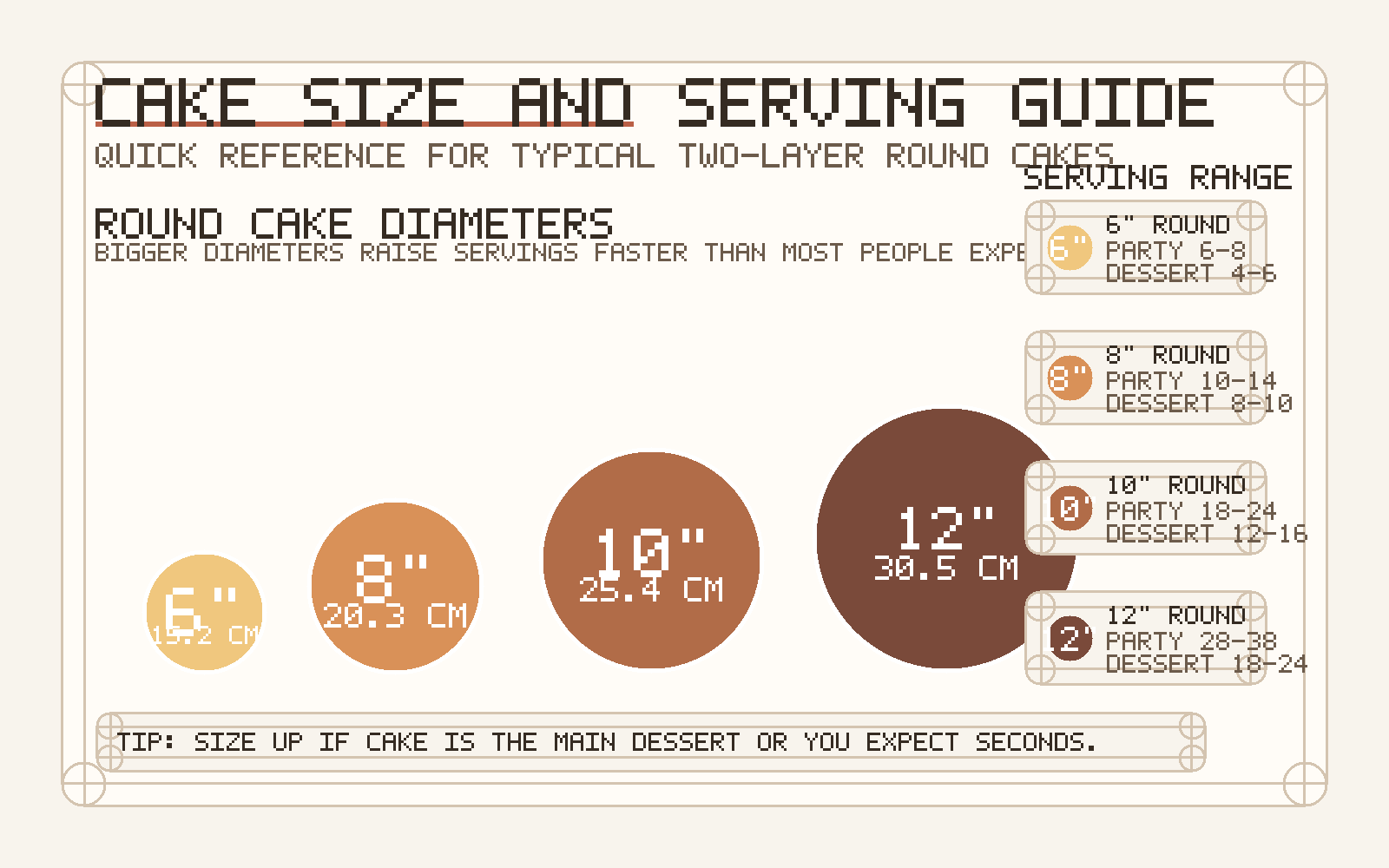
Standard cake sizes and how many people they serve
The table below gives practical serving ranges for common round cakes. These are not rigid laws. They are planning ranges that work well for typical two-layer celebration cakes.
| Cake size | Approximate diameter | Party servings | Dessert servings | Best use |
|---|---|---|---|---|
| 6-inch round | 15.2 cm | 6 to 8 | 4 to 6 | Small birthday, date night, close family dinner |
| 8-inch round | 20.3 cm | 10 to 14 | 8 to 10 | Standard family celebration, small office gathering |
| 10-inch round | 25.4 cm | 18 to 24 | 12 to 16 | Medium party, school event, larger family celebration |
| 12-inch round | 30.5 cm | 28 to 38 | 18 to 24 | Large event, buffet service, multi-family gathering |
The useful pattern is this: every jump in diameter increases servings more than many people expect. Going from 8 inches to 10 inches does not feel dramatic on the order form, but it can change whether you are feeding a small group or a full room.
A quick guest-count guide
If you want a faster decision, use this simplified guide:
- Up to 6 guests: 6-inch cake
- 8 to 12 guests: 8-inch cake
- 12 to 20 guests: 10-inch cake
- 20 to 35 guests: 12-inch cake or a tall 10-inch cake
- 35+ guests: consider a tiered cake or sheet cake support
This quick list works best when cake is one dessert among several. If the cake is the featured dessert, lean toward the top end of each range or move up one size.
Example scenarios
Here are a few realistic examples that show how the same guest count can lead to different choices:
Example 1: 10 guests at a birthday dinner
You are serving one main dessert after dinner. People will probably want full slices. An 8-inch cake is usually the safe choice, and a tall 8-inch cake is even better if you want leftovers for the next day.
Example 2: 18 guests at a baby shower
There are also cookies, fruit, and tea sandwiches. Most guests will take a small slice. A 10-inch cake should work well, especially if the baker cuts party-style portions.
Example 3: 30 guests at an office celebration
People are eating while standing and chatting. Neat, small slices are ideal. A 12-inch round cake can work, but two smaller cakes may be easier to serve and transport.
Example 4: 50 guests at a wedding reception
A single round cake is rarely the easiest answer. A two-tier cake for display plus a kitchen cake or sheet cake for extra servings is usually the calmer, more efficient plan.
How to avoid the two most common sizing mistakes
Mistake 1: Ordering by appearance alone
It is easy to choose a cake that looks beautiful in photos and forget that visual scale does not equal serving capacity. Tall frosting, flowers, toppers, and thick borders can make a cake look substantial without changing how many slices it yields. Always ask for the expected serving count, not just the diameter.
Mistake 2: Forgetting the menu around the cake
If guests already had a heavy meal, dessert portions may shrink. If your event is mostly coffee, tea, and cake, portions may grow. That tradeoff matters. A lighter menu usually increases cake demand, while a crowded dessert table lowers it.
Practical next step: write down the full food plan before you change anything about the cake order. Once you see the whole menu on paper, the right size is usually easier to spot.
When a tiered cake makes more sense
Tiered cakes are not only for weddings. They are useful any time you need more servings without relying on one very wide cake. They also help when you want a centerpiece effect for photos.
Consider a tiered cake when:
- You need servings for more than 35 guests.
- You want separate flavors in one presentation.
- You need to combine style and function for a formal event.
- You want a small top tier for display and additional servings below.
Common combinations include:
- 6-inch + 8-inch: useful for roughly 18 to 24 party servings
- 6-inch + 10-inch: useful for roughly 24 to 32 party servings
- 8-inch + 10-inch: useful for roughly 30 to 40 party servings
- 6-inch + 8-inch + 10-inch: useful for larger formal events where presentation matters
If cost is a concern, ask whether a small decorated tiered cake can be paired with a simpler sheet cake cut in the kitchen. Guests still receive proper servings, and the display cake can stay elegant without carrying the whole workload.
How tall cakes and sheet cakes change the decision
Round cakes get most of the attention because they look celebratory, but height and backup formats matter just as much as width. A tall cake can serve more guests than a shorter cake of the same diameter, and a sheet cake can quietly solve the “we need more portions” problem without changing the decorated centerpiece.
Here is a practical way to think about it:
- Tall round cake: good when you want more servings without taking up more table space.
- Standard round cake: good for straightforward family or office gatherings.
- Sheet cake: good when serving efficiency matters more than dramatic presentation.
- Display cake plus kitchen cake: good for weddings, showers, and milestone events where appearance and serving count both matter.
If you are hosting a practical event rather than a highly styled one, do not overlook the humble sheet cake. It is easier to transport, easier to portion, and often more cost-effective per serving. That does not make it less festive. It just means the planning is doing its job quietly, which is often the best kind of planning.
When to choose two smaller cakes instead of one larger cake
Two smaller cakes can be the better option when:
- You want two flavors without paying for a fully tiered design.
- You need one cake to be allergen-aware and the other standard.
- Your refrigerator or transport container cannot handle a very wide cake.
- You want one cake on the dessert table and one held back for later service.
For example, two 8-inch cakes can be easier to manage than one large cake for a mixed crowd of 18 to 24 guests, especially if one cake is chocolate and one is vanilla. The slices stay tidy, the flavor choice is simple, and serving feels more flexible.
Special tips for birthdays, weddings, and casual gatherings
For children’s birthdays
- Keep slices smaller, especially for younger children.
- Count adults separately; they often want cake too, just more politely.
- Add a little extra if the party includes games, outdoor play, or a long activity window.
For weddings and milestone events
- Choose a cake size based on servings first, then decorate around that plan.
- If the event has plated dessert, the cake can be smaller.
- If cake cutting is a photo moment, tiered structure may matter as much as flavor.
For casual home gatherings
- Leftovers are usually a benefit, not a problem.
- A slightly larger cake can feel generous without being wasteful if guests take slices home.
- Simple cakes are often easier to store, transport, and slice than dramatic designs.
What to ask your baker before you order
If you are ordering from a bakery, these questions save time and reduce mistakes:
- How many party servings and dessert servings does this size provide?
- How tall is the cake?
- How many layers are included?
- Do decorations change usable servings?
- Can you provide a small separate cake for dietary needs?
- What size do you recommend for my exact guest count and menu?
A good baker answers these clearly. If the responses stay vague, that is a sign to ask again before you pay. Cake should be delightful. Guesswork is optional.
A simple formula you can use at home
If you want a quick planning method, use this:
- Estimate the number of guests likely to eat cake.
- Decide whether they will take party slices or dessert slices.
- Add a 10% to 15% buffer for seconds, larger slices, or a few unexpected guests.
- Round up when you are between sizes.
Example: 22 guests are attending a graduation party. You expect 18 to 20 to eat cake, and portions will be moderate because other desserts are available. Add a small buffer and you land in 20 to 22 servings. That points to a 10-inch cake if portions stay tidy, or a 12-inch cake if you prefer extra flexibility.
A last-minute cake sizing checklist
If you are ordering today and do not want to overthink it, run through this quick checklist before checkout:
- Guest reality check: How many people are actually expected, not just invited?
- Dessert role check: Is cake the only dessert or one of several options?
- Slice size check: Are you picturing tidy party slices or full plated dessert slices?
- Menu check: Will guests already have had a heavy meal?
- Age mix check: Are children, teens, and adults all represented?
- Diet check: Do you need a second cake or a separate dessert option?
- Storage check: Can the cake travel safely and fit where it needs to go?
If three or more of those answers feel uncertain, round up one size. That is usually the safer tradeoff. A slightly larger cake is easier to recover from than a too-small cake once plates are already in people’s hands.
One simple planning chart
| If your guest count is… | And dessert is… | A practical choice is… |
|---|---|---|
| 6 to 8 | The main dessert | 6-inch tall cake or 8-inch standard cake |
| 10 to 15 | One of several sweets | 8-inch cake |
| 16 to 24 | Main dessert or centerpiece | 10-inch cake or two 8-inch cakes |
| 25 to 40 | Served buffet-style | 12-inch cake, tiered cake, or display cake plus sheet cake |
| 40+ | Formal or high-traffic event | Tiered cake with backup servings prepared separately |
If you create event guides, portion notes, or planning checklists for a group, a simple web app generator can be a useful resource for organizing forms and serving information in one place.
Final takeaway
Choosing the right cake size is mostly about matching the cake to the room in front of you. Guest count, serving style, and event format matter more than decoration alone. Start with the number of people likely to eat cake, choose realistic slice sizes, and round up when you are close to the line.
To summarize the key points:
- Use guest count as your base number, not just invitations.
- Adjust for party slices versus full dessert slices.
- Check height, layers, and presentation before you assume a size will be enough.
- Choose tiered or split-cake options for larger or more formal events.
- Plan a separate option for dietary needs when necessary.
When in doubt, plan slightly more cake rather than slightly less. Leftover cake usually disappears with impressive efficiency, which is one of the friendlier truths of event planning.